Compulsory social medical insurance
The Compulsory Social Health Insurance (CSHI) system has been in effect since January 1, 2020. Its introduction has more than doubled healthcare funding. In 2019, before the launch of CSHI, approximately KZT 1 trillion was allocated to the Guaranteed Volume of Free Medical Care. In 2023, more than KZT 2.5 trillion was allocated to finance medical care for the population, including KZT 1.4 trillion under the Guaranteed Volume of Free Medical Care and more than KZT 1 trillion under CSHI.
The significant increase in healthcare funding through CSHI has improved access to medical care.
Key Principles of the CSHI System
Social orientation — the state pays contributions for 11 million citizens belonging to 15 eligible categories.
Shared responsibility — the state, employers, and citizens share responsibility for the health of the population.
Equal access to medical care — every insured person is entitled to the necessary scope of medical care regardless of the amount of contributions paid.
Money follows the patient — patients may choose the medical organization where they wish to receive medical services, provided that the organization is a healthcare provider contracted by the Fund.
Protection of patients’ rights — the Fund pays medical organizations for healthcare services only after monitoring the quality and scope of the medical care provided.
Guaranteed Volume of Free Medical Care
The Guaranteed Volume of Free Medical Care (GVFMC) is funded from the state budget and is provided to:
- citizens of the Republic of Kazakhstan;
- kandas;
- refugees;
- foreign nationals permanently residing in the Republic of Kazakhstan (and holding a residence permit);
- stateless persons permanently residing in the Republic of Kazakhstan (and holding a residence permit).
Foreign nationals and stateless persons temporarily staying in the Republic of Kazakhstan, as well as asylum seekers, are entitled to receive the Guaranteed Volume of Free Medical Care for diseases that pose a threat to others.
The Guaranteed Volume of Free Medical Care is provided to citizens regardless of their insurance status.
The Guaranteed Volume of Free Medical Care (GVFMC) includes:
Emergency Medical Services
Emergency medical services, including medical aviation services in certain cases.
Primary Health Care (PHC)
Including:
- Diagnosis, treatment, and management of the most common diseases;
- Preventive examinations of target population groups (children and adults);
- Immunization (vaccination);
- Promotion and development of a healthy lifestyle;
- Reproductive health protection measures;
- Monitoring of pregnant women and women during the postpartum period;
- Sanitary and anti-epidemic and sanitary preventive measures at sites of infectious disease outbreaks.
Specialized Outpatient Medical Care
- Prevention and diagnosis of HIV infection and tuberculosis;
- Services for injuries, poisoning, and other emergency conditions, including mobile medical team services for diseases that may worsen the epidemiological situation in the country and suspected cases of such diseases, for all persons regardless of insurance status;
- Diagnosis and treatment of socially significant diseases;
- Diagnosis and treatment of chronic diseases requiring ongoing medical monitoring.
Specialized Medical Care in Day-Care and Hospital-Substitution Settings
- Treatment of socially significant diseases;
- Home hospital services for diseases that may worsen the epidemiological situation in the country and suspected cases of such diseases, for all persons regardless of insurance status;
- Treatment of chronic diseases requiring ongoing medical monitoring.
Specialized Inpatient Medical Care
Provided:
- When isolating persons who have been in contact with a patient suffering from an infectious or parasitic disease that poses a threat to others, as well as bacterial carriers, virus carriers, and persons suspected of having an infectious or parasitic disease that poses a threat to others;
- For the treatment of infectious and parasitic diseases and other diseases that pose a threat to others;
- As emergency care to individuals regardless of insurance status, including diagnostic and therapeutic procedures performed in the admissions department of a 24-hour hospital;
- As scheduled inpatient care.
Medical Rehabilitation
- During treatment of the underlying disease;
- For patients with tuberculosis.
Palliative Care
Palliative medical care is provided within the Guaranteed Volume of Free Medical Care.
Blood and Blood Components
Provision of blood products and blood components when medically indicated as part of specialized medical care.
Pathological Diagnosis
Pathological diagnosis provided as part of specialized medical care in outpatient, day-care/hospital-substitution, and inpatient settings.
Treatment Abroad and Involvement of Foreign Specialists
Referral of citizens of Kazakhstan for treatment abroad and/or involvement of foreign specialists to provide treatment at healthcare organizations in Kazakhstan.
Medicines and Medical Products
Provision of medicines, medical devices, specialized therapeutic nutritional products, and immunobiological medicinal products.
Compulsory Social Health Insurance (CSHI)
Citizens who regularly pay contributions to the Compulsory Social Health Insurance (CSHI) system and have “INSURED” status are entitled to a broader range of medical services without having to pay additional fees.
The Compulsory Social Health Insurance package includes:
Outpatient Medical Care
(Diagnosis and treatment of diseases)
- Preventive medical examinations, except for those provided under the Guaranteed Volume of Free Medical Care (GVFMC);
- Appointments and consultations with specialized healthcare professionals upon referral from primary health care (PHC) physicians;
- Ongoing monitoring by specialized healthcare professionals of patients with chronic diseases;
- Emergency and scheduled dental care for certain categories of the population;
- Diagnostic services, including laboratory diagnostics in accordance with the approved list;
- Other procedures and medical interventions included in the approved list.
Specialized Medical Care in Day-Care and Hospital-Substitution Settings
Specialized medical care, including high-tech medical care, provided in day-care and hospital-substitution settings, except for the treatment of diseases covered by the GVFMC.
This also includes home hospital services for diseases that may worsen the epidemiological situation in the country and for suspected cases of such diseases.
Specialized Inpatient Medical Care
Specialized medical care, including high-tech medical care, provided as scheduled inpatient treatment, except for the treatment of diseases covered by the GVFMC.
Emergency Specialized Inpatient Care
Emergency specialized inpatient care, including diagnostic and therapeutic procedures performed in the admissions department of a 24-hour hospital until a diagnosis is established that does not require treatment in a 24-hour inpatient setting, except for cases involving diseases covered by the GVFMC.
Medical Rehabilitation
Medical rehabilitation services.
Pathological Diagnosis
Pathological diagnostic services.
Preparation of a Deceased Donor
Medical procedures related to the preparation of a deceased donor.
Provision of Medicines and Medical Devices
Within the CSHI system, medicines and medical devices are provided as part of:
- Specialized medical care, including high-tech medical care, in inpatient and day-care/hospital-substitution settings in accordance with the pharmaceutical formularies of healthcare organizations;
- Primary health care and specialized outpatient medical care in accordance with the list of medicines and medical devices approved by the authorized body for certain categories of citizens with specified diseases or medical conditions.
Who Pays CSHI Contributions and How Much?
As of January 1, 2023, due to increases in the minimum wage (MW) and the Monthly Calculation Index (MCI), the contribution and deduction amounts for Compulsory Social Health Insurance (CSHI) have changed.
Employers — 3% of an employee’s salary, but no more than KZT 21,000, as the contribution calculation base may not exceed 10 minimum wages. IMPORTANT: If an employee belongs to one of the 15 eligible categories, the employer is not required to make CSHI contributions for that employee.
Employees, including individuals receiving income under civil-law contracts — 2% of their income, but no more than KZT 14,000, as the contribution calculation base may not exceed 10 minimum wages.
Individual entrepreneurs and persons engaged in private practice — 5% of 1.4 times the minimum wage, or KZT 4,900.
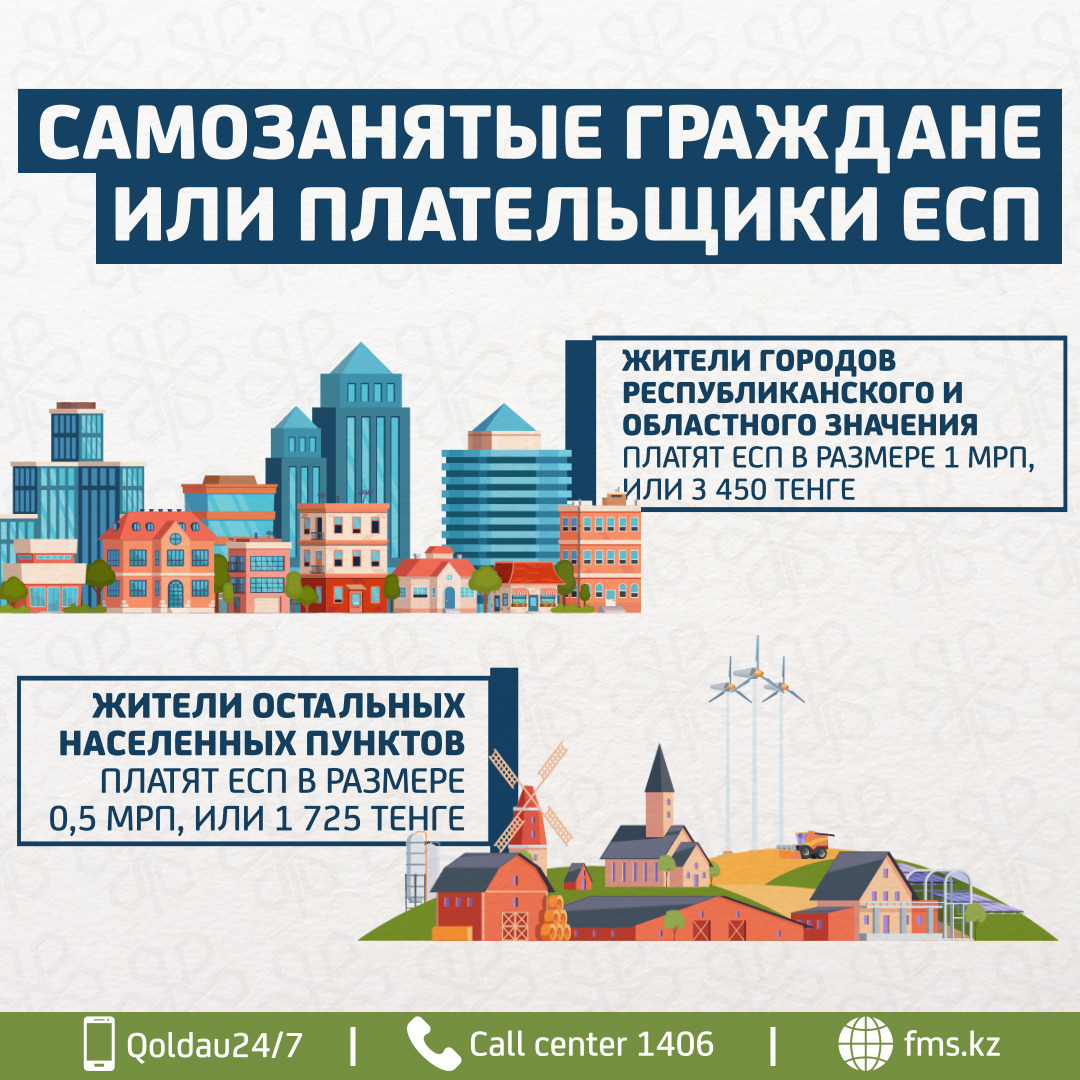
Self-employed citizens pay the Unified Aggregate Payment (UAP):
— for residents of the capital, cities of republican significance, and cities of regional significance — 1 MCI, or KZT 3,450;
— for residents of other localities — 0.5 MCI, or KZT 1,725.
Independent payers — 5% of the minimum wage, or KZT 3,500.
The state pays CSHI contributions for citizens belonging to 15 eligible categories — more than 11 million people. In the current year, the contribution paid by the state for each person amounts to KZT 4,505.6.
How to Obtain Insured Status
Following an instruction from the Head of State, amendments to the Law “On Compulsory Social Health Insurance”came into effect on September 5, 2022, introducing an alternative way to participate in the CSHI system.
Previously, to obtain insured status, a person was required to have contributions paid for the preceding 12 months. If payments were missing during this period, outstanding contribution arrears would arise. Under the new mechanism, insured status can be obtained by paying contributions for the next 12 months, meaning that it is not necessary to settle outstanding contributions for the previous year.
Therefore, to obtain insurance coverage for one year in advance, contributions of KZT 3,500 must be paid separately for each month. It is important to make 12 separate payments, because if the entire amount of KZT 42,000 is paid as a single payment, the system will not assign insured status under the new mechanism.
CSHI contributions can be paid through any second-tier bank, banking mobile applications, quick-payment terminals, or branches of Kazpost.

Categories Insured by the State
The eligible categories whose CSHI contributions are paid by the state include:
- children under the age of 18;
- unemployed pregnant women;
- unemployed persons raising a child under the age of three;
- persons on leave due to pregnancy and childbirth, adoption of a newborn child, as well as childcare leave until the child reaches the age of three;
- mothers of large families awarded the “Altyn Alqa” or “Kumis Alqa” pendants, those who previously received the title “Mother Heroine,” as well as those awarded the “Maternal Glory” Orders, 1st and 2nd Class;
- unemployed persons caring for a child with a disability;
- persons caring for individuals with disabilities since childhood;
- persons with disabilities;
- pensioners and veterans of the Great Patriotic War;
- full-time students enrolled in secondary, technical and vocational, post-secondary, higher, and postgraduate educational institutions;
- persons officially registered as unemployed;
- unemployed recipients of state targeted social assistance;
- unemployed oralman;
- persons serving sentences imposed by a court in institutions of the penal system, except for minimum-security institutions;
- persons held in pre-trial detention facilities.
If you belong to one of these categories but do not have insured status, you need to collect the required supporting documents and submit them to a Public Service Center (PSC). The information will then be forwarded to the relevant government authorities for verification.
Once all necessary procedures have been completed, the state will pay CSHI contributions on your behalf, and you will be granted “INSURED” status as a member of an eligible category.
How to Check Your CSHI Status
There are several ways to check your status in the Compulsory Social Health Insurance system.
Egov.kz E-Government Portal
In the “Healthcare” section, find the service “Provision of Information on Participation as a Consumer of Medical Services and on the Amounts of Deductions and/or Contributions Transferred within the Compulsory Social Health Insurance System.”
Click “Order Service” and enter your Individual Identification Number (IIN). The result will be available within 10 minutes.
Official Website of the Social Health Insurance Fund — fms.kz
The “Check Status” pop-up window is located on the right-hand side of the website. Simply click it and enter your IIN.
Qoldau 24/7 Mobile App
In the menu, select “Check Insurance Status” and enter your IIN. Your insurance status and information about payments made during the previous 12 months will then be displayed.
The app can be downloaded from Google Play and the App Store.
@SaqtandyrýBot on Telegram
To launch the bot, open:
or enter its name in the Telegram search bar. Then select “Check Insurance Status” and enter your IIN.
You can also obtain information about deductions and contributions made on your behalf by requesting the government service “Provision of Information on Participation as a Consumer of Medical Services and on the Amounts of Deductions and/or Contributions Transferred within the Compulsory Social Health Insurance System” at:
https://egov.kz/cms/ru/services/health_care/pass171-2_mz
Protection of Patients’ Rights
If you are dissatisfied with the quality of medical services provided, have been refused medical care, experienced inappropriate or rude treatment by medical staff, encountered demands for payment for medical services that should be provided under the Guaranteed Volume of Free Medical Care (GVFMC) or the Compulsory Social Health Insurance (CSHI) system, or have faced other issues, you have the right to protect your rights as a patient.
There are several ways to do this.
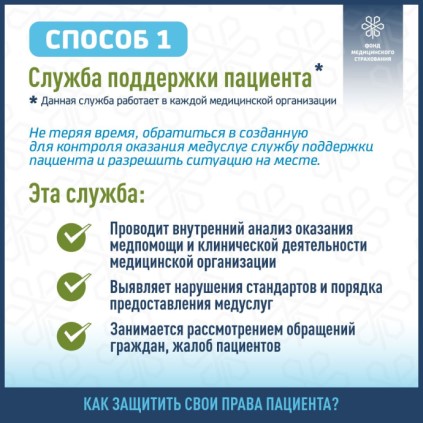
Contact the Patient Support and Internal Audit Service
Every healthcare organization has a Patient Support and Internal Audit Service. You can submit a written complaint or request, including your contact details so that you can receive a response.
More detailed information is available at the reception desk of your clinic or hospital.
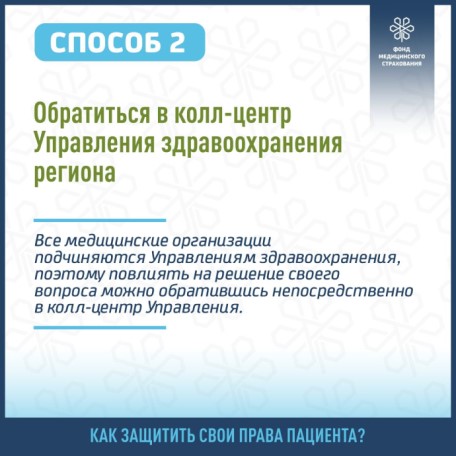
Contact the call center of your regional Health Department. Since healthcare organizations are overseen by regional health authorities, their representatives may be able to assist in resolving your issue.
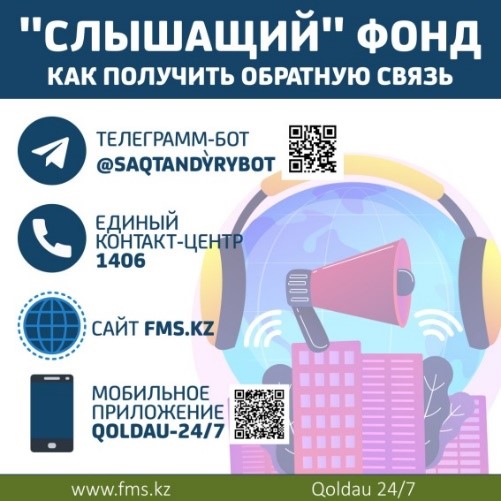
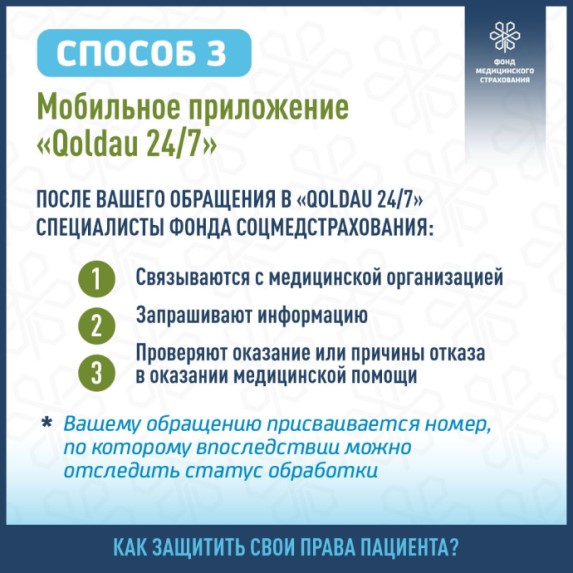
Submit a request through the Qoldau 24/7 mobile app. After you submit your request, specialists from the Social Health Insurance Fund will contact the healthcare organization and review the quality of the service provided. If, for any reason, you did not receive the service, they will investigate the reason for the refusal.
All requests are entered into a registry and assigned a registration number, which allows you to track the status of your request.
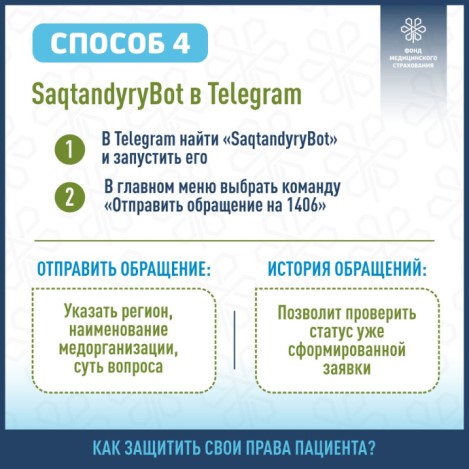
Submit a request via @SaqtandyrýBot on Telegram. In the main menu, select “Send a Message to 1406.” Your request should include a description of the issue, as well as the name of the region and the healthcare organization.
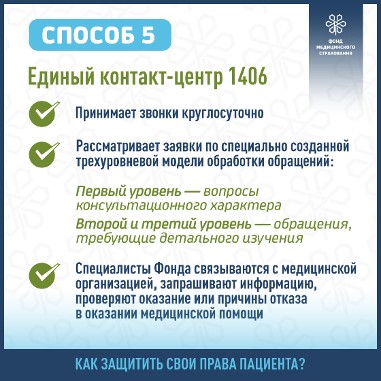
Contact the Fund’s 24/7 Unified Contact Center at 1406. Calls from both mobile and landline phones are free of charge throughout Kazakhstan.
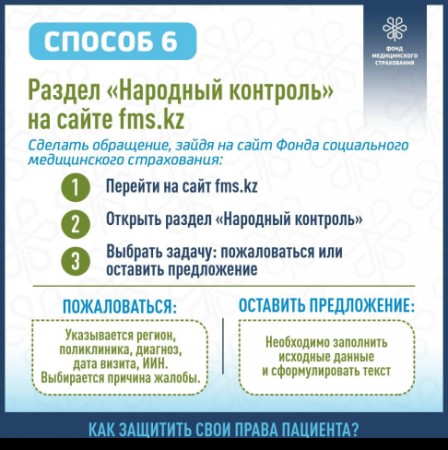
Submit a request through the official website of the Social Health Insurance Fund — fms.kz. Select “Submit a Request,” then the “Ask a Question / Submit a Complaint” window will open, where you will need to complete all required fields.
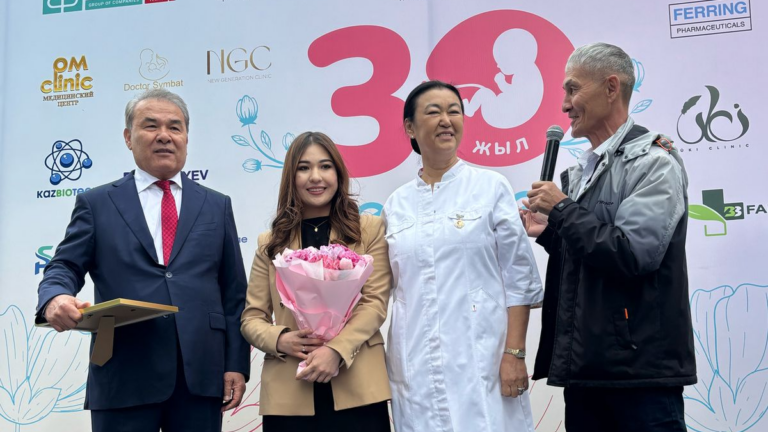
Artificial intelligence will help Kazakhstani reproductologists from Ecomed to more effectively combat infertility

Over 3 years, thanks to the “Ansagan Sabi” program, 7 thousand babies were born